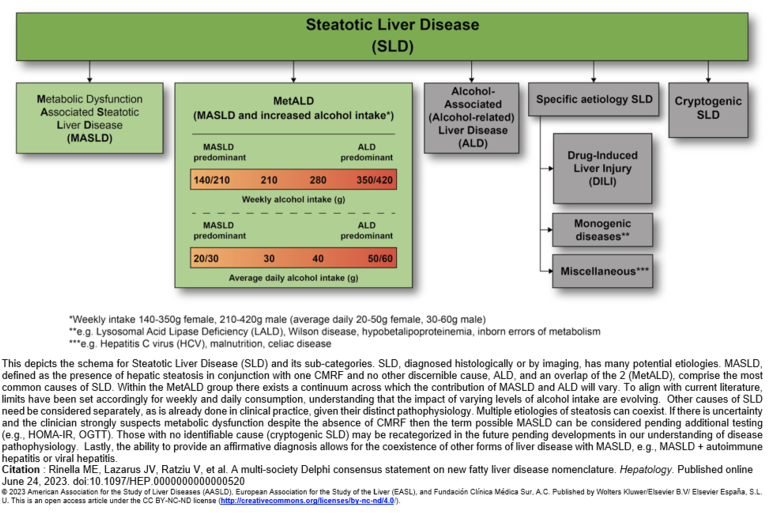
In 2023, a Delphi committee was convened to update the nomenclature of nonalcoholic fatty liver disease. The rationale for this change was because of the recognition that "nonalcoholic" did not accurately capture the etiology (cause) of the disease. In addition, "fatty" was viewed as stigmatizing by some. A new nomenclature was developed to recognize steatotic liver disease (SLD) as a spectrum of conditions based on the identification of significant alcohol use and/or metabolic risk factors[1].
In response, the Steatotic Liver Foundation made several updates to the survey including:
- updating the survey name to "The State of Steatotic (Fatty) Liver Care in America"
- expanding eligibility to any individual diagnosed with a condition under the SLD umbrella term and not just MASLD or MASH
- adding a question to specify SLD sub-classification diagnosis
- where relevant, updating question answer choices to be more inclusive of the expanded eligible population
Key Findings
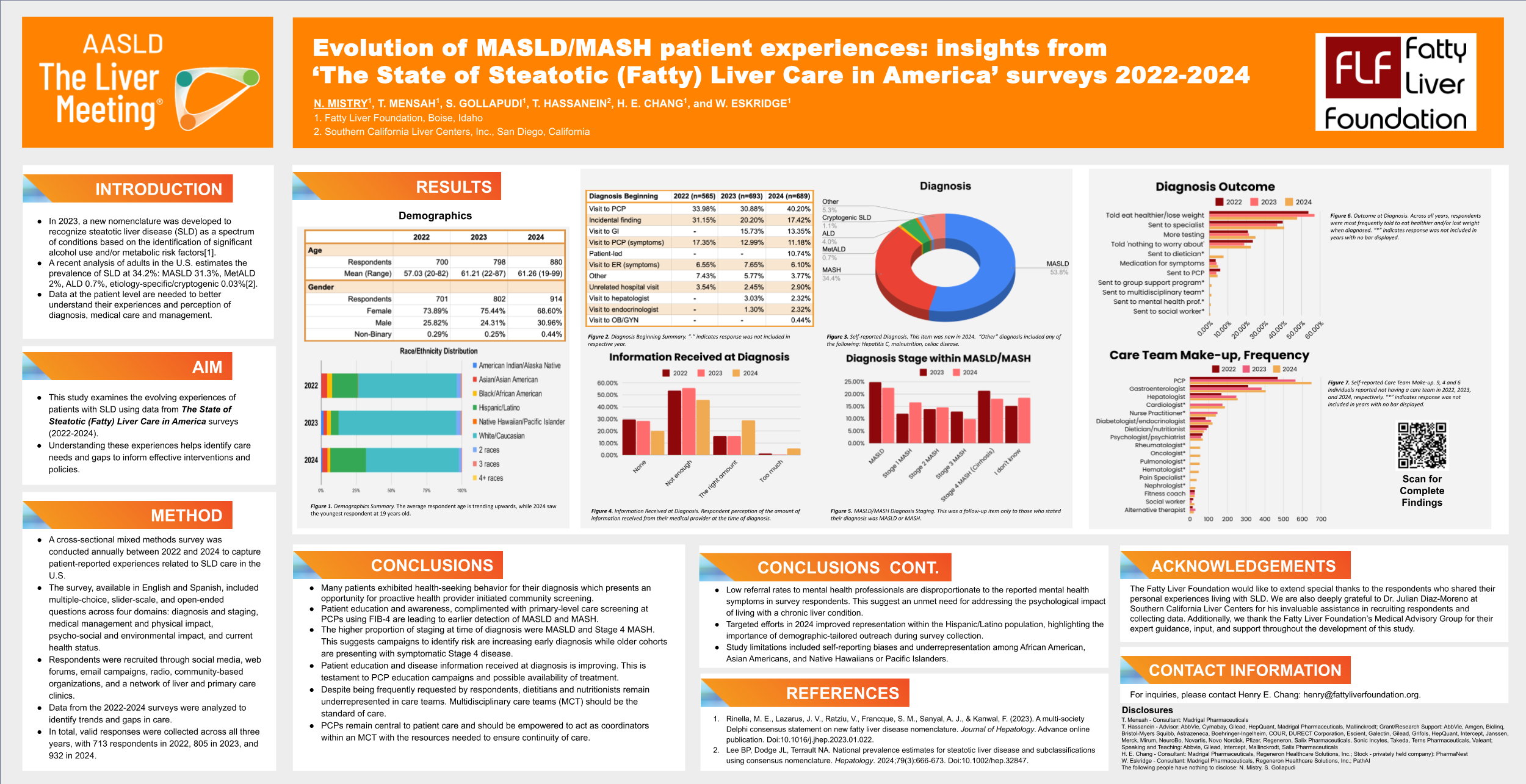
- Many patients showed health-seeking behavior for their diagnosis which presents an opportunity for proactive health provider initiated community screening.
- Patient education and condition information received at diagnosis is improving though there is still much room for improvement.
- Despite being frequently requested by respondents, dietitians, nutritionists, and fitness coaches remain underrepresented in care teams. Multidisciplinary care teams (MCTs) should be the standard of care for people living with SLD.
- Primary care physicians remain central to patient care and should be empowered to act as coordinators within an MCT with the resources needed to ensure continuity of care.
- Low referral rates to mental health professionals are disproportionate to the mental health symptoms reported by respondents. This suggests an unmet need for addressing the phycological impact of living with a chronic liver condition.
Beyond the Report
What the 2024 Fatty Liver Survey Tells Us About the Patient Journey
In this Community Conversation, we delve into the findings of the Steatotic Liver Foundation's 2024 State of Steatotic (Fatty) Liver Care in America survey, which captures the real-life experiences of adults living with steatotic liver disease.
Conclusiones Clave
- Muchos pacientes mostraron un comportamiento de búsqueda de salud para su diagnóstico, lo que presenta una oportunidad para una evaluación comunitaria proactiva iniciada por un proveedor de salud.
- La educación del paciente y la información sobre su condición recibida en el momento del diagnóstico están mejorando, aunque todavía hay mucho margen de mejora.
- A pesar de que los encuestados los solicitan con frecuencia, los dietistas, nutricionistas y entrenadores físicos siguen estando subrepresentados en los equipos de atención. Los equipos de atención multidisciplinarios deberían ser el estándar de atención para las personas que viven con EHE.
- Los médicos de atención primaria siguen siendo fundamentales para la atención al paciente y se les debe capacitar para actuar como coordinadores dentro de un equipo multidisciplinario con los recursos necesarios para garantizar la continuidad de la atención.
- Las bajas referencias a profesionales de la salud mental son desproporcionadas con respecto a los síntomas de salud mental que informan los encuestados, lo que sugiere que existe una necesidad insatisfecha de abordar el impacto psicológico de vivir con una enfermedad hepática crónica.
References
1. Rinella, M. E., Lazarus, J. V., Ratziu, V., Francque, S. M., Sanyal, A. J., & Kanwal, F. (2023). A multi-society Delphi consensus statement on new fatty liver disease nomenclature. Journal of Hepatology. Advance online publication. Doi:10.1016/j.jhep.2023.01.022.